
As many as 23 companies have evinced interest in acquiring the Indian space agency's Small Satellite Launch Vehicle technology, said a top official who termed it a "tremendous response". Chairman of Indian National Space Promotion and Authorisation Centre (IN-SPACe) Pawan K Goenka said on Thursday that they are keen to see how the private sector uses the Small Satellite Launch Vehicle (SSLV) technology. "There has been a tremendous response, 23 companies have (so far) shown interest in applying for this technology.
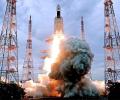
ISRO is developing a third launch pad at Shriharikota to accommodate heavier satellites and next-generation launch vehicles. The new facility will support both crewed and uncrewed missions.

The EoI comes at a time when ISRO is working to enhance LVM3's payload capacity to five tonnes in GTO and is also evaluating the procurement of a Russian semi-cryogenic engine for the vehicle's second stage.

Weighing 6,100 kg, the communication satellite would be the heaviest payload to be placed into the Low Earth Orbit (LEO) in LVM3 launch history from Indian soil.
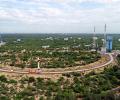
The Polar Satellite Launch Vehicle (PSLV) in its 63rd mission, would carry the earth observation satellite (EOS-09) which would be capable of capturing high-resolution images of the Earth's surface under all weather conditions.

The satellite, weighing about 4,410 kg will be the heaviest to be launched from the Indian soil and into a Geosynchronous Transfer Orbit (GTO), the space agency said. The satellite will travel onboard a LVM3-M5 rocket, dubbed as 'Bahubali' for its heavylift capability.

India and the US on Wednesday marked their maiden space collaboration with the successful flight of a GSLV rocket that placed an earth observation satellite, jointly developed by the two space agencies, in a precise orbit.

ISRO is set to launch its communication satellite CMS-03 from Sriharikota. The satellite, weighing 4,410 kg, will be the heaviest launched from Indian soil into a Geosynchronous Transfer Orbit (GTO).

A high-level committee investigating the failures of ISRO's PSLV rockets, which have impacted strategic satellite missions, has yet to release its report and recommendations, raising concerns about the future of the ageing launch vehicle.
ISRO chairman announces plans for nine major launches by the end of the fiscal year, including the Blue Bird Block2 communication satellite for the US in collaboration with NASA.
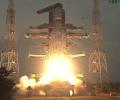
The heaviest communication satellite to be launched from the Indian soil onboard a new generation, homegrown 'Bahubali' rocket was successfully placed into the intended orbit on Sunday, the Indian Space Research Organisation said.

India's move to privatise PSLV rocket production through IN-SPACe has triggered debate over national security, ageing technology and the agency's role.

These upcoming launches carry added significance in light of setbacks suffered in recent years.

Based on the broadcast visuals, a rocket expert said the failure appeared similar to the anomaly seen during the PSLV-C61 mission.

India is set to take its first steps towards its own human space flight when the uncrewed Gaganyaan mission soars to the skies later this year. Private players in the space sector are also gearing up for launching satellites on home-built rockets.

The main focus of the all weather RISAT-1B satellite will be to observe the Indian land with its C-band synthetic aperture radar.

ISRO has announced plans for seven launch missions by March, including the first uncrewed mission for the Gaganyaan project and demonstrations of new satellite technologies.

'The LVM3 rocket will orbit one Block 2 BlueBird satellite in Low Earth Orbit.'
A PSLV rocket carrying Earth observation satellite EOS-09 failed to launch from the Sriharikota spaceport early on Sunday.

In a landmark journey into a new era of space application, India successfully launched its first dedicated navigation satellite using the Polar Satellite Launch Vehicle, which blasted off from the Satish Dhawan Space Centre in Sriharikota, Andhra Pradesh.

ISRO stated that the disengagement of at least one contact -- in both the main and redundant paths -- of a connector led to the failure of NVS-02.

Jeff Bezos' Blue Origin experienced a major setback as its New Glenn rocket exploded during an engine-firing test at a launch pad in Florida, raising concerns about its ability to compete with SpaceX in the commercial space race.

Noting that the PSLV was a versatile launch vehicle which can do different jobs and put satellites in different orbits, he said streamlining of this operation with improved capabilities is on.

Police in Bengaluru have launched an investigation after an unmanned aerial vehicle was allegedly spotted flying over the ISRO's ISITE campus, a designated 'No Drone Zone'. The incident occurred on May 2, prompting a complaint by a CISF sub-inspector.

The 3,357-kg satellite, which was deployed from the lower passenger position of Ariane-5 launch vehicle (VA 251) into the geostationary transfer orbit, is configured on ISRO's enhanced I-3K Bus structure to provide communication services from Geostationary orbit in C and Ku bands.
The 44.5-metre-tall, 295-tonne PSLV-C7 lifted off from the launch pad at 9.24 am.

The move follows a quiet visit by National Security Advisor Ajit Kumar Doval to the Vikram Sarabhai Space Centre in Thiruvananthapuram.
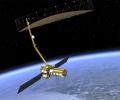
NISAR will not be used for surveillance and will be used to observe the earth.
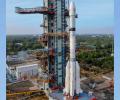
At 6.23 am on 29.1.2025, the 50.9 metre tall and weighing 420.7 ton Geosynchronous Satellite Launch Vehicle-F15 (GSLV-F15) is slated to blast off from the second launch pad carrying the 2,250 kg NVS-02 navigation satellite.
ISRO to launch a 6,500 kg communication satellite built by the US, marking a significant milestone in the Indian space program after the successful launch of the NASA-ISRO NISAR mission.

Thursday's launch is the last one of 2020 for ISRO.
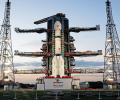
The imaging technology in Nisar can provide very high-resolution data on changes as small as one centimetre in size on the earth's surface.
State-run Hindustan Aeronautics Limited has won a bid under which it will receive technology from the Indian Space Research Organisation for the end-to-end commercial production of the Small Satellite Launch Vehicle (SSLV), a first for the industry as India seeks to become a global hub for small satellite manufacturing and launches.

The polar satellite launch vehicle's 52nd mission is scheduled for lift-off at 15.41 hours on Thursday from the second launch pad at the spaceport of Sriharikota 'subject to weather conditions'.
'A solid motor, once ignited, burns until the propellant is exhausted. It cannot simply stop mid-burn,' said a retired senior ISRO official. 'That is what makes this failure puzzling.' Venkatachari Jagannathan reports on the latest PSLV failure.
ISRO Chairman V Narayanan has emphasised the critical role of mission operations in ensuring the success of India's expanding space programme. He highlighted this at the Spacecraft Mission Operations conference, noting the importance of sustained teamwork and operational precision, particularly for long-duration missions like Chandrayaan-3 and the upcoming Gaganyaan programme.

The GSAT-31 is a 'high power' communication satellite going to serve and replace some of the satellites that are going to expire soon.

The Indian Space Research Organisation (ISRO) on Monday successfully launched its maiden X-Ray Polarimeter Satellite that would offer several insights into celestial objects like black holes.
NASA has announced three missions to the moon as part of efforts to establish a permanent base on the earth's natural satellite. The USD 20 billion plan includes lunar rovers and drones for experiments to help master skills to live and operate in the dangerous environment.

ISRO's first mission in 2023 and SSLV's sequel saw a strange coincidence--it was launched at 9.18 am, the same time its predecessor lifted off from the Satish Dhawan Space Centre here on August 7, 2022 but could not deliver due to orbit anomaly and flight path deviation.
